Tubulinea
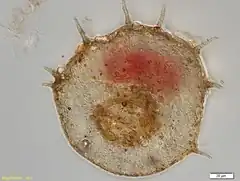
| Règne | Protozoa |
|---|---|
| Sous-règne | Sarcomastigota |
| Embranchement | Amoebozoa |
| Sous-embr. | Lobosa |
Classe
Les Tubulinea sont une classe de protistes de l'embranchement des Amoebozoa.
Description
Les Tubulinea sont un groupe d'amibes caractérisées par leurs pseudopodes tubulaires, subcylindriques ou capables de modifier leur forme locomotrice d'un aspect aplati et élargi vers un aspect subcylindrique. De plus, leur cytoplasme émet un flux monoaxial dans chaque pseudopode ou dans la cellule entière[1].
Ce taxon regroupe des protistes amiboïdes aplatis, élargis ou réticulés formant des structures uroïdales (c'est-à-dire en forme de queue) adhésives et ne possédant pas de glycocalyx différencié[2].
Liste des ordres et familles
Selon IRMNG (4 janvier 2025)[3] :
- Arcellinida
- Arcellidae Ehrenberg, 1843
- Bipseudostomatidae Snegovaya & Alekperov, 2005
- Centropyxidae Jung, 1942
- Cryptodifflugiidae
- Cylindriflugiidae González-Miguéns et al., 2022
- Difflugiidae
- Distomatopyxidae
- Heleoperidae
- Hyalospheniidae Schulze, 1877
- Lamtopyxidae
- Lesquereusiidae
- Microchlamyiidae
- Microcoryciidae
- Nebelidae
- Netzeliidae Kosakyan, Lara, Gomaa & Lahr in Kosakyan et al., 2016
- Paraquadrulidae
- Phryganellidae
- Plagiopyxidae
- Shamkiriidae Snegovaya & Alekperov, 2005
- Trigonopyxidae
- Echinamoebida
- Echinamoebidae Page, 1975
- Vermamoebidae Cavalier-Smith & Smirnov in Smirnov, Chao, Nassonova & Cavalier-Smith, 2011
- Euamoebida
- Amoebidae Ehrenberg, 1838, stat. nov. Page, 1987
- Hartmannellidae Volkonsky, 1931 emend. Smirnov et al., 2011
- Nolandellidae Cavalier-Smith in Smirnov et al., 2011
- Copromyxaceae : ⇔ Copromyxidae et Hartmannellidae
- Copromyxidae Olive & Stoianovitch in Olive, 1975 ⇔ Hartmannellidae
- Leptomyxida
- Flabellulidae Bovee, 1970 emend. Page, 1987
- Gephyramoebidae Pussard & Pons, 1976
- Leptomyxidae Pussard & Pons, 1976 emend. Page, 1987
- Rhizamoebidae Smirnov, Nassonova, Geisen, Bonkowski, Kudryavtsev, Berney, Glotova, Bondarenko, Dyková, Mrva, Fahrni & Pawlowski, 2017
- Trichosida
- Trichosidae Möbius, 1889 ⇔ Trichosphaeriidae Sheehan & Banner, 1973 (invalide, ne dérive pas directement d'un nom de genre)
Selon World Register of Marine Species (4 janvier 2025)[4] :
- Arcellinida
- Arcellidae
- Centropyxidae
- Cryptodifflugiidae
- Difflugiidae
- Hyalospheniidae
- Lesquereusiidae
- Microchlamyiidae
- Phryganellidae
- Trigonopyxidae
Selon GBIF (4 janvier 2025)[5] :
- Leptomyxida
- Nolandellidae
- Trichosphaeriidae
Selon The Taxonomicon (4 janvier 2025)[6] :
- Arcellinida Kent, 1880 - Amibes lobées à coquille
- Arcellidae Ehrenberg, 1843
- Centropyxidae Jung, 1942
- Cryptodifflugiidae Jung, 1942
- Difflugiidae Wallich, 1864
- Distomatopyxidae Bonnet, 1970 [monotype]
- Echinamoebidae Page, 1975 [monotype]
- Heleoperidae Jung, 1942
- Hyalospheniidae Schultze, 1877
- Lamtopyxidae Bonnet, 1974 [monotype]
- Lesquereusiidae Jung, 1942
- Microchlamyiidae Ogden, 1985
- Microcoryciidae de Saedeleer, 1934
- Nebelidae Taranek, 1882
- Nolandellidae Cavalier-Smith, 2011 [monotype]
- Paraquadrulidae Deflandre, 1953
- Phryganellidae Jung, 1942 [monotype]
- Plagiopyxidae Bonnet & Thomas, 1960
- Trigonopyxidae Loeblich & Tappan, 1964
- Vermamoebidae Cavalier-Smith & Smirnov, 2011 [monotype]
- Euamoebida Lepşi, 1960
- Amoebidae Ehrenberg, 1838
- Hartmannellidae Volkonsky, 1931
- Leptomyxida Pussard & Pons, 1976
- Flabellulidae Bovee, 1970
- Gephyramoebidae Pussard & Pons, 1976 [monotype]
- Leptomyxidae Pussard & Pons, 1976
Systématique
Le nom valide de ce taxon est Tubulinea Smirnov (d), Nassonova (d), Berney (d), Fahrni (d), Bolivar (d) & Pawlowski (d), 2005 [3],[7] .
Tubulinea a pour synonyme[5] : Acarpomyxa.
Publication originale
- (en) Alexey Smirnov, Elena Nassonova, Cédric Berney, José Fahrni, Ignacio Bolivar et Jan Pawlowski, « Molecular Phylogeny and Classification of the Lobose Amoebae », Protist, Elsevier, vol. 156, no 2, , p. 129-142 (ISSN 1434-4610 et 1618-0941, PMID 16171181, DOI 10.1016/J.PROTIS.2005.06.002, lire en ligne).
Liens externes
- (en) AlgaeBase : classe Tubulinea Smirnov et al. (+classification) (consulté le )
- (en) Catalogue of Life : Tubulinea Smirnov, Nassonova, Berney, Fahrni, Bolivar & Pawlowski, 2005 (consulté le )
- (fr + en) EOL : Tubulinea (consulté le )
- (fr + en) GBIF : Tubulinea (consulté le )
- (fr) INPN : Tubulinea Smirnov, Nassonova, Berney, Fahrni, Bolivar & Pawlowski, 2005 (TAXREF) (consulté le )
- (en) IRMNG : Tubulinea Smirnov, Nassonova, Berney, Fahrni, Bolivar & Pawlowski, 2005 (consulté le )
- (en) NCBI : Tubulinea (taxons inclus) (consulté le )
- (en) OEPP : Tubulinea (consulté le )
- (en) Paleobiology Database : Tubulinea (consulté le )
- (en) Taxonomicon : Tubulinea Smirnov et al., 2005 (consulté le )
- (en) WoRMS : Tubulinea Smirnov et al., 2005 (+ liste espèces) (consulté le )
Notes et références
- ↑ (en) M. Sina et al., « The Revised Classification of Eukaryotes », Journal of Eukaryotic Microbiology, 2012, vol. 59, n. 5, p. 429–493, DOI 10.1111/j.1550-7408.2012.00644.x (lire en ligne, p. 433).
- ↑ (en) Alexey Smirnov et al., « Phylogeny and Systematics of Leptomyxid Amoebae (Amoebozoa, Tubulinea, Leptomyxida) », Protist, 2017, vol. 168, n. 2, p. 220-252 (lire en ligne).
- 1 2 Rees, T. (compiler). The Interim Register of Marine and Nonmarine Genera. Available from https://www.irmng.org at VLIZ, consulté le 4 janvier 2025.
- ↑ World Register of Marine Species, consulté le 4 janvier 2025.
- 1 2 GBIF Secretariat. GBIF Backbone Taxonomy. Checklist dataset https://doi.org/10.15468/39omei accessed via GBIF.org, consulté le 4 janvier 2025.
- ↑ Brands, S.J. (ed.), 1989-present. The Taxonomicon. Universal Taxonomic Services, Zwaag, The Netherlands. [http://taxonomicon.taxonomy.nl/], consulté le 4 janvier 2025.
- ↑ Smirnov et al. 2005, p. 129–142
 Portail de la microbiologie